The Remembered Soldier by Anjet Daanje, translated by David McKay (Scribe, 576 pp.)
I will not lie, I was rather devastated when this book did not make it
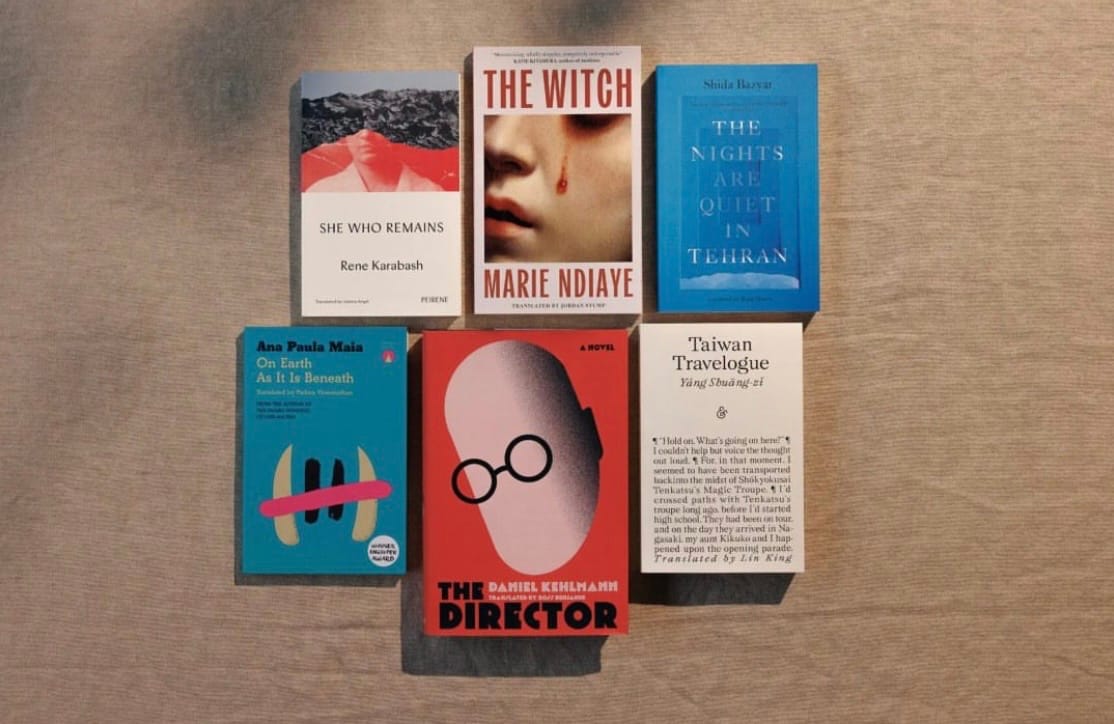
I will not lie, I was rather devastated when this book did not make it through the Booker International Shortlist. I had hoped to review it next as part of the list. Now, I must quickly read of the three books this month to find one to talk about. I say one of the three because I have already read two of them, one of which I even talked about here:
https://www.litnet.co.za/penafrican-the-nights-are-quiet-in-tehran-by-shida-bazayr-a-book-review/
I shall not mention yet the other one because it is currently my favourite to win, and so would love to talk about closer to the announcement date on the 8th May 2026.
So, below I talk about why I had hoped The Remembered Soldier would win.
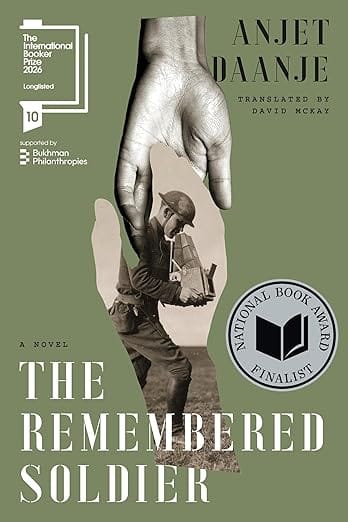
And is a sentence structure that governs The Remembered Soldier by Anjet Daanje and translated from Dutch by David McKay. From the opening line to the last it goes like this: And. Every paragraph, every scene, very nearly every sentence in Anjet Daanje’s sprawling, hypnotic novel begins with the word ‘And’ — that low, patient conjunction that refuses the drama of the full stop, that insists on continuation, on life as an unbroken accretion of moments rather than a sequence of decisive events.
This is one of the more audacious formal choices in recent European fiction, and the fact that it works by seducing the reader to sink into it rather than chafing against it is a measure of how completely Daanje has thought through the relationship between style and subject.
Her novel is about a man who has no past. The endless unspooling present tense of her prose is his condition made grammar. And more than that, it becomes a philosophy of duration, a refusal to grant catastrophe the dignity of finality, and a syntax that insists experience does not end but merely alters its pace.
The man is a Belgian soldier discovered behind the front lines near Merckem in December 1917. He is disoriented, silent, apparently amnesiac, a body without narrative in the aftermath of industrial war. He is given the name Noon Merckem by the Catholic asylum near Ghent where he is housed along with the shell-shocked, the traumatised, and the genuinely mad — a taxonomy of suffering that collapses under scrutiny.
The novel opens four years after this discovery, in 1922, as the asylum doctor places advertisements in the newspapers inviting women to come and identify him: a wife, perhaps, or a mother, or merely someone willing to recognise him into existence. Several women arrive. The first is beautiful, elegant, disappointed. Noon is not her husband, and her disappointment is so overwhelming that it becomes his shame, a shame without memory but a force of present. The second is practical and resigned, her grief for a missing spouse already worn to numbness, already metabolised into routine. The third — a small, plainly dressed woman with a drawling voice and a strange, unguarded happiness — calls him Amand. She has a scar above his temple to prove it, a detail at once trivial and decisive, the kind of embodied evidence that resists argument.
This is Julienne, née Vandevoorde, and she is among the most vividly realised female characters in the translated fiction I have read in years. She is working-class, sharp-tongued, proud, manipulative, tender, and entirely specific, the kind of character whose contradictions do not cancel each other but accumulate into density. She married above herself, or so the neighbourhood sees it when she married Amand Coppens, a photographer, a man of modest but still superior standing, and has spent the intervening years being made to feel this in a thousand small humiliations. Her mother-in-law is a refined tormentor; the respectable women of Kortrijk treat her as a social climber; the war widows who might have been her community of grief turn away from her. Julienne has survived all this with a formidable inner life and a very limited capacity for self-deception about the world around her, though a rather larger one about herself. What she has done is bent reality until her missing, probably dead husband has become the shape of whatever she most needed him to be. When she walks through the door of the asylum doctor’s office and sees Noon in his straitjacket (he has refused to cooperate; they have restrained him), her face opens with an unguarded joy that undoes him entirely. She allows herself to think he is her husband. And for a few extraordinary sentences, we understand why someone might do this, and how it works, and what it costs — the psychic labour required to sustain a world against the evidence of its collapse.
The novel that follows is, in its quiet way, a study in the phenomenology of identity, and more precisely in the ethics of inhabitation. Noon — or Amand, or Louis, as he eventually turns out to be — must navigate a life assembled for him by someone else’s memories, a life that precedes him and into which he must fit as though retroactively. He wears Amand’s suits. He sleeps in Amand’s bed. He learns to speak in Amand’s voice, or at least not to contradict it. And gradually, with a patience that Daanje renders in minute and convincing detail, he comes to inhabit this borrowed self. The most interesting part is that he is not deceived. What he dreads most is the alternative of a blankness so complete it does not only resembles an ontological vacancy but death. The asylum, for all its deprivations and humiliations, gave him a self: Monday routines, a vegetable garden, the company of men whose suffering was legible to him even if his own was not. What Julienne offers is something else, a future as a person someone else recognises, with a name and a past and a place in the social fabric of a Flemish city. He knows it is a fiction but he cannot afford not to take it. And in that decision lies one of the novel’s quiet propositions about identity; that it is less of a discovery, or memory of the past than a concession to the conditions under which one can continue.
Daanje is meticulous about the social texture of post-war Belgium in a way that shames much historical fiction I have read so far. Her best weapon of delineation and articulation is not display but saturation. The novel is set across a decade and several locations — the asylum outside Ghent, Kortrijk with its bomb-damaged station and its fine Groote Markt, briefly Johannesburg during a false lead that gestures toward the wider circuits of empire and migration, and finally the Rhineland where the truth, when it comes, arrives with the muted force of something long suspected. Daanje has very little interest in the war itself as spectacle or event; it appears only in the aftermath, in the nightmares and paralysed limbs and compulsive confessions of the asylum patients, in the photographs Julienne and Amand make of wounded veterans — portraits that restore, through the alchemy of the studio, the faces the war has disfigured. This reconstruction of men is Julienne’s enterprise. Her photographic practice and her relationship with Noon are the same act performed twice, an aesthetic and emotional labour of repair that borders on invention.
The question the novel circles, without ever quite asking it directly, is whether this reconstruction is a lie or a form of love, or perhaps insinuates that the distinction is inadequate. Julienne knows, at some level, that Noon is not Amand. She suppresses this knowledge with such skill and persistence that she appears to herself to believe it genuinely, and there are long sections of the novel in which the reader, like Noon, finds themselves uncertain where the performance ends. What Daanje understands, and renders with particular acuity, is that Julienne’s need for Amand to have survived is not merely romantic self-delusion. It is a claim about what she is entitled to, which is the marriage she made and the life she was building against the cruelties of fate, to the social standing she purchased at great personal cost by leaving her class and her people of low class. For Amand to be dead is for everything to have been for nothing. For Noon to be Amand is for it all to have been worth it. This is not sentimental but a survival strategy, a politics of the intimate.
The novel’s structural gamble is to give us Amand’s German wife, Käthe, only in the final third — first as a rumour, then as a memory that slowly becomes undeniable, and finally as a presence in a German farmyard who looks at Noon-Amand-Louis across a landscape of mutual loss and wordlessly tells him she has made another life. By this point we have spent hundreds of pages with Julienne and come to understand her as a fully formed person, not an antagonist. The scenes in Germany could easily tip into melodrama — two women, one man, a secret identity. Daanje gives us instead something more unsettling, the portrait of a man discovering that the self he recovered in Germany — Louis, with his German wife and two children and his platoon memories — is no longer available to him, any more than the blank of the asylum was. Identity, once distributed across attachments, cannot simply be reclaimed intact. He is returned, by the logic of accumulated attachment, to Julienne and to the name she gave him, not because it is truer but because it is now inhabited.
The novel’s final line is one of the most quietly devastating in recent fiction. After the whole long journey — the asylum, the Flemish years, the trip to Germany, the walk back through rain — Louis walks into Julienne’s shop and, when she asks whether he found Käthe, he says: I am Amand. Not because it is true but because it is the only self he has left that anyone can love. Or because, by now, the distinction between truth and habitation has collapsed under the weight of lived time, under the sedimentation of daily acts performed in a borrowed name. The novel does not choose between these readings. The conjunction that governs it — And — refuses closure, refuses the grammar of resolution, and in doing so mimics the ethical ambiguity it has so patiently constructed.
David McKay’s translation is a considerable achievement. The ‘And’ construction, which in the original Dutch presumably carries its own aural weight, must have presented formidable problems in English, where the device risks monotony and affectation in equal measure. McKay’s solution is to let the rhythm accumulate slowly, trusting the reader to surrender to it in the way one surrenders to a long musical phrase, or to the iterative cadences of oral storytelling. There are moments, particularly in the first hundred pages, where the sustained present tense feels effortful. But by the middle of the novel it has become the only register available; to shift from it would feel like violence. This is a translator working at the edge of what the target language can absorb, and mostly succeeding, preserving not only sense but temporal experience.
Daanje published The Remembered Soldier in Dutch in 2019; this English translation arrives in 2025, which means it has crossed the language barrier with a delay long enough for its context to have shifted. What reads now partly as a novel about European memory and the aftermath of catastrophic violence also reads as a novel about the instability of identity more broadly: about how much of what we call the self is narrative, and how much of narrative is the willing suppression of what we know. In this light, Julienne’s insistence that Noon is Amand becomes less a pathology and more a compressed version of what all of us do, all the time, in the stories we tell about who we are and who we have chosen to become — an existential editing that sustains continuity.
For a South African reader, the novel carries an additional, almost inadvertent resonance. The idea of a self constructed under pressure, of identities assumed, erased, or strategically inhabited in order to survive systems of violence and classification, echoes uneasily with histories of pass laws, forced removals, and the bureaucratic inscription of personhood. Americans have a term for it: Passing. Daanje’s novel does not allegorise identity but it illuminates it as a shared human condition: the necessity, under certain pressures, of becoming someone one is not in order to remain someone at all.
The novel is long, and it earns its length. It has the particular confidence of a writer who trusts accumulation over event, who believes that the repetition of small domestic gestures: the tying of a tie, the scrubbing of a floor, the hanging of laundry, will, if attended to with sufficient care, eventually reveal the whole of a life. And in this accumulation there is also an ethics of attention as a form of recognition, duration as a form of truth.
Daanje is, in this sense, a Flemish realist in the great tradition, but she is also something stranger and more formally ambitious, a novelist who has found a sentence structure that is itself an argument about memory, about continuation, about what it means to go on. And — as she would say — to go on, even knowing what you know, even after everything, is perhaps the most human thing there is.